

Every major loss in the digital asset market typically shares a single point of origin: an investment made without asking the right questions. Investors often buy into a price spike or social media hype without evaluating the underlying infrastructure. When the sentiment shifts, their capital evaporates.
While no methodology can entirely eliminate risk in such a volatile market, a structured evaluation dramatically improves your odds. By separating projects with genuine utility from those built on pure speculation or fraud, you protect your portfolio. This guide outlines the fundamental pillars every investor should audit before committing capital.
Factor 1: the whitepaper and use case
The whitepaper is the architectural blueprint of a crypto project. A high-quality document must define a concrete problem and provide a technically sound, blockchain-based solution.
Red flags to monitor:
- Vague technical implementation details.
- Plagiarized content from established protocols.
- Over-reliance on marketing « buzzwords » rather than technical documentation.
Factor 2: team credibility and track record
In a decentralized ecosystem, the execution capability of the core team is a primary success driver. Verifiable professional histories in blockchain, finance, or cryptography are essential. While some legitimate projects remain anonymous for privacy reasons, transparency generally reduces the risk of accountability avoidance. Check LinkedIn profiles and past project contributions to gauge their ability to deliver on a roadmap.
Factor 3: technology and development activity
A project without active development is functionally stagnant. By auditing the project’s GitHub repository, you can verify:
- Commit frequency: Are updates regular?
- Contributor diversity: Is the code maintained by a robust group or a single individual?
- Technical innovation: Does the project offer a unique value proposition, or is it a simple « fork » of an existing protocol?
Factor 4: tokenomics and economic structure
Even the most advanced technology can fail as an investment if the economic model is flawed. Tokenomics analysis identifies potential selling pressure before it hits the market.
Key metrics to evaluate:
- Circulating vs total supply: Significant gaps indicate future dilution through token unlocks.
- Vesting schedules: When do early investors and team members gain the right to sell?
- Utility: Does the token have a functional necessity within the ecosystem (fees, staking, governance)?
- Concentration: Do a few « whales » hold a dangerous percentage of the total supply?
Factor 5: liquidity and market structure
Liquidity defines your ability to enter and exit a position without significant slippage. Thinly traded assets might show impressive gains, but those gains often vanish during a market correction when holders attempt to liquidate. Monitor trading volumes across multiple reputable exchanges and evaluate the TVL (Total Value Locked) for DeFi protocols.
Factor 6: community and social momentum
Community is the engine of adoption. However, engagement rate is a far more reliable metric than raw follower counts, which are easily manipulated by bots.
Look for organic discussions centered on technology and use cases rather than pure price speculation. A resilient community supports a project through market cycles, providing a long-term competitive advantage.
Factor 7: security and audit status
Billions have been lost to smart contract exploits. Before interacting with any protocol, verify the existence of third-party audits from recognized firms such as Certik, Trail of Bits, or OpenZeppelin. Ensure that the vulnerabilities identified in the reports were actually resolved and that the last audit is recent enough to cover the current code version.
Factor 8: on-chain data and whale activity
On-chain data offers a transparent, unfiltered view of economic reality. Unlike social sentiment, which can be manufactured, on-chain metrics track actual behavior:
- Active address growth: A direct signal of organic adoption.
- Exchange flows: Large inflows often precede sell-offs, while outflows suggest long-term holding.
- Whale monitoring: Tracking the movement of large wallets provides an early warning system for significant market shifts.
How cryptoscores covers all these factors automatically
Manually auditing these eight factors for every potential investment is a massive undertaking. It requires navigating dozens of platforms, from explorers to social sentiment trackers.
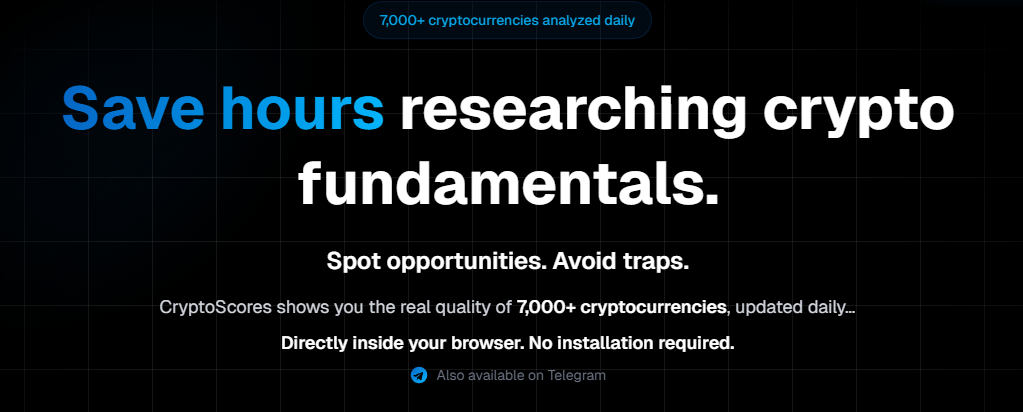
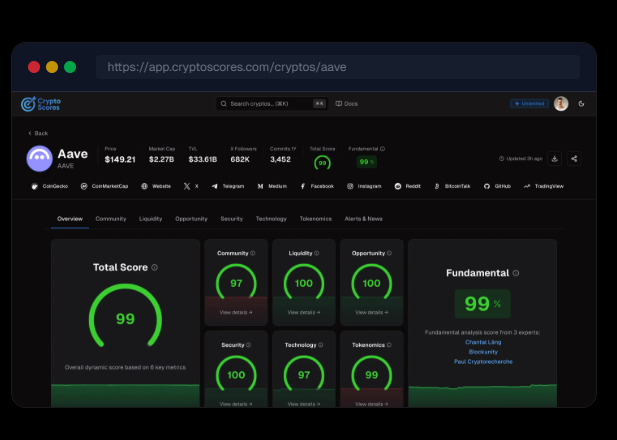
cryptoscores automates this entire lifecycle. By processing 100+ metrics across all the dimensions mentioned in this guide, the platform delivers a comprehensive analysis in roughly 10 seconds.
By aggregating data from 15+ institutional-level sources—including coingecko, defillama, lunarcrush, github, and artemis—cryptoscores synthesizes the results into a dynamic total score. This allows you to review fundamentals, security, and on-chain signals in one centralized dashboard.
Structure your research, protect your capital
A systematic, data-driven approach is the foundation of responsible investing. While no tool can guarantee a profit, a structured framework ensures that your decisions are based on objective reality rather than emotional hype.
Start evaluating projects with professional precision at www.cryptoscores.com — your 14-day free trial is available now.